

The Israeli Pilots Association magazine
The Israeli Air Force’s new aerial refueling aircraft is already here. The importance of the “Gideon” becomes especially clear in light of the lessons of the June 2025 “Am K’lavie” war against Iran. During the campaign, the IAF operated hundreds of fighter aircraft, intelligence platforms, and other aerial assets at ranges it had never before been required to sustain.

When the wheels of the Israeli Air Force’s new KC-46A “Gideon” aerial refueling aircraft touched down earlier this month on the runway at Nevatim Air Base, it was far more than a ceremonial induction of another aircraft. In fact, it marked one of the most important strategic leaps made by the IAF in recent decades. Advanced fighter jets, precision munitions, and impressive intelligence systems, however capable, cannot operate for long periods or at great distances without the most essential element in modern air warfare: fuel.
In that sense, the “Gideon” is not merely a tanker aircraft. It is a strategic force multiplier. It enables fighter aircraft to fly farther, remain over the target area longer, return safely, and above all, provide decision-makers with operational flexibility that did not previously exist.
The arrival of the “Gideon” marks the beginning of the replacement of one of the oldest aerial refueling fleets in the world. For decades, the IAF has relied on its “Re’em” tankers, a military refueling version of civilian Boeing 707 aircraft manufactured in the 1960s and 1970s. Although this platform has repeatedly proven itself in covert operations and long-range flights, time has taken its toll. Maintenance has become more complex, spare parts have become rarer, and the technological gap between the old platform and modern threats has continued to grow.
Facing this aging platform is now the “Gideon” – a new-generation tanker aircraft based on the Boeing 767-2C, one of the most reliable and widely used platforms in the world. The aircraft was developed for the United States Air Force under the name KC-46A "Pegasus", and today it is considered one of the most advanced aerial refueling aircraft in service anywhere.
The numbers tell part of the story. The “Gideon” can carry approximately 90.7 tons of fuel, about 15 percent more than the veteran “Re’em” aircraft. But the real advantage lies not only in the amount of fuel, but in how efficiently it is used. Its two modern turbofan engines consume significantly less fuel than the four older engines of the 707, meaning that a larger share of the enormous fuel load carried by the aircraft can actually be transferred to fighter jets.
Within the IAF, the assessment is that thanks to the combination of greater fuel capacity and lower self-consumption, the “Gideon” can perform up to 50 percent more refueling operations during a single sortie. In a world where every additional fighter reaching the target may influence the outcome of a campaign, this is an operationally significant figure.
But the true importance of the “Gideon” is measured not in numbers, but in its impact on the future battlefield. In an era in which Israel’s main threats are located thousands of kilometers from its borders – foremost among them Iran – tanker aircraft have become a critical link in every operational plan.
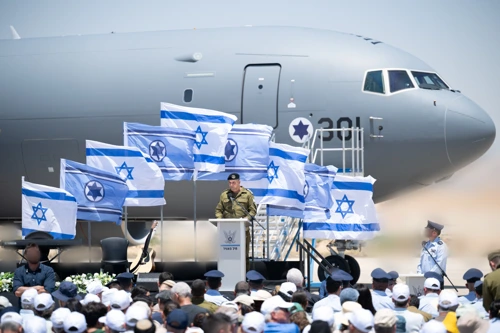
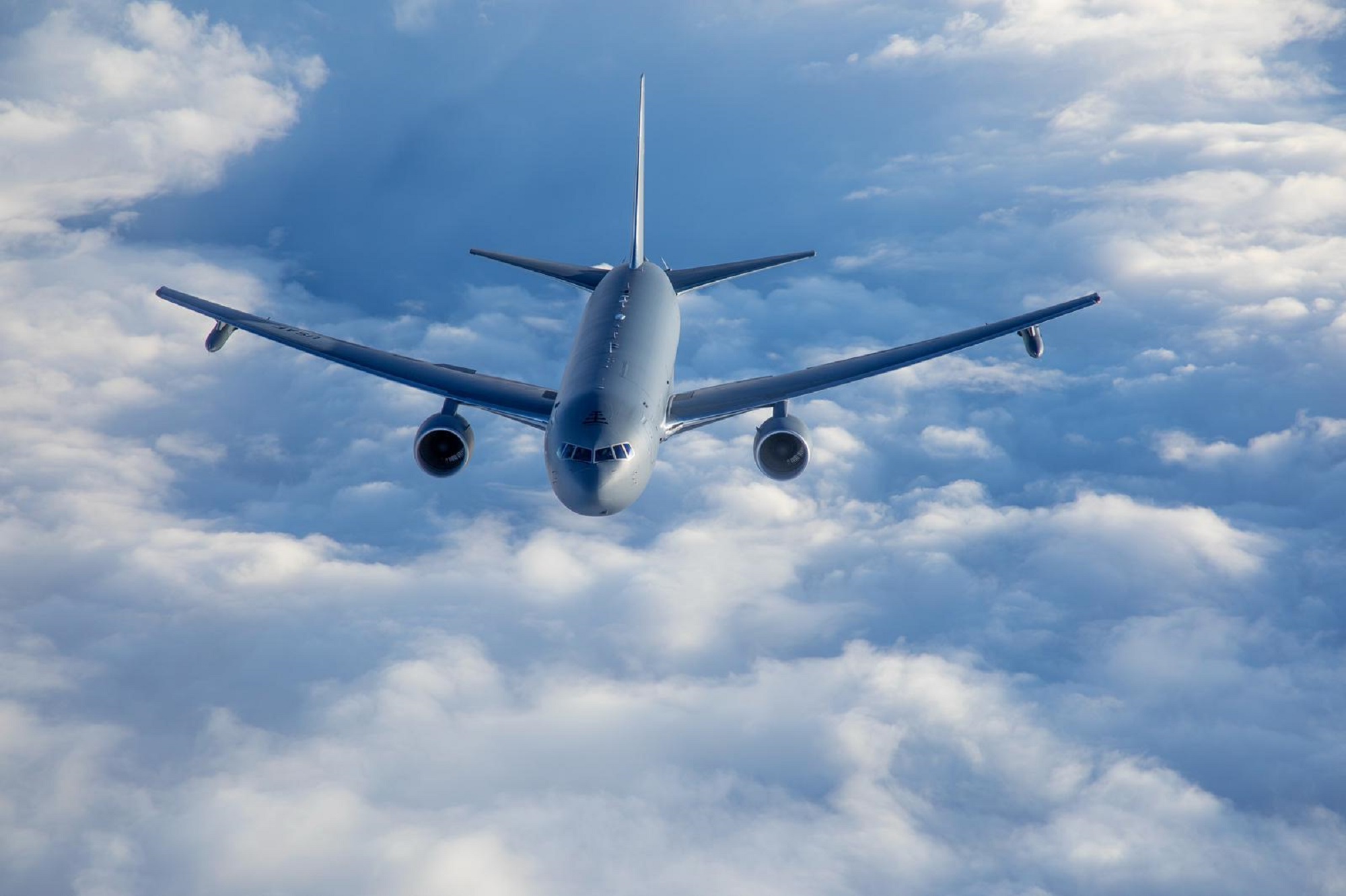
Indeed, anyone seeking to understand how the Israeli Air Force can operate deep inside Iran must begin with aerial refueling. F-35I “Adir” aircraft, F-15I “Ra’am” fighters, and the future F-15IA model acquired by Israel and expected to enter IAF service toward the end of the decade, are all capable of impressive ranges. But prolonged presence over the target, repeated sorties within the same operation, or the flexibility to alter plans in real time all require aerial refueling.
This is where the “Gideon” enters the picture. It allows fighter aircraft to take off with maximum weapons loads rather than external fuel tanks, extend their time in the operational area, and respond to unexpected developments. In other words, it gives the IAF not only greater range, but also greater freedom of action.
Another advantage lies in survivability. While the “Re’em” aircraft were originally developed as civilian airliners and later converted for military use, the KC-46A was designed from the outset to operate in a threatened operational environment. The aircraft is equipped with missile-defense systems, advanced electronic warfare capabilities, warning systems, and infrastructure that allows it to be adapted to modern threats.
In Israel, the “Gideon” will undergo an additional process of “Israelization,” during which unique communications, command-and-control, intelligence, and defense systems developed for the IAF will be integrated into the aircraft. This is a process that has already proved itself with the F-35, enabling an advanced American platform to become an aircraft tailored precisely to Israel’s operational needs.
One of the most prominent innovations in this aircraft is the refueling system itself. In the past, the boom operator sat at the rear of the aircraft and looked directly at the receiving aircraft. In the “Gideon,” the traditional method has been replaced by a digital camera system and an advanced three-dimensional display. The refueling operator sits at a modern workstation inside the aircraft and manages the entire contact process using sensors and high-resolution cameras.
The aircraft can use both a rigid boom system and a hose-and-drogue system, enabling it to refuel almost every aerial platform in IAF service – from F-35 and F-15 fighters to "Yas'ur" (CH-53) and "Yanshuf" (Black Hawk) helicopters and other aircraft.
Yet perhaps the most impressive advantage of the “Gideon” is that it is not only a tanker. It is a truly multi-mission aircraft. Within a short time, it can be converted from a refueling aircraft into a transport aircraft, an airborne medical evacuation platform, or an aircraft capable of carrying forces and equipment over long distances. It can carry more than 30 tons of cargo or dozens of troops, and in a medical evacuation configuration it can function as a full airborne hospital.
This is one of the reasons many countries regard new-generation tanker aircraft as strategic assets rather than merely support platforms for fighter jets. They provide a state with operational, logistical, and humanitarian flexibility in war and in peacetime.
The induction of the “Gideon” is not the end of the road, but the beginning. Israel has ordered six aircraft. The first has already landed, additional aircraft are expected to arrive gradually over the coming years, and the United States has also approved the possibility of expanding the purchase in the future.
At first glance, a tanker aircraft may appear less glamorous than a stealth fighter or a heavy bomber. It does not carry missiles, it does not penetrate defended airspace, and it rarely dominates headlines. But the men and women of the IAF know very well that in modern wars, victory belongs not only to the aircraft that fires – but also to the aircraft that enables it to reach the target.
The importance of the “Gideon” becomes especially clear in light of the lessons of the June 2025 “Am K’lavie” war against Iran. During the campaign, the IAF operated hundreds of fighter jets, intelligence aircraft, and additional aerial platforms at ranges it had never before been required to sustain, with some sorties flown more than 1,500 kilometers from Israel’s borders.
Such an operation relied heavily on the ability of the refueling fleet to keep aircraft airborne for hours, enable operational flexibility, and deliver fuel to fighters at different points along the route. The veteran “Re’em” tankers fulfilled their mission successfully and once again demonstrated the quality of their crews, but the war also underscored the limitations of a platform designed more than half a century ago.
The IAF understood that in an era in which Iran, Yemen, and other theaters lie within Israel’s operational reach, it needs a modern tanker aircraft with higher survivability, improved reliability, and the ability to support significantly larger volumes of activity. In this sense, the “Gideon” is not merely the successor to the “Re’em”; it is one of the central lessons incorporated into the IAF’s force buildup following the war.
In conclusion, the “Am K’lavie” war proved that the road to Tehran does not necessarily begin in the cockpit of a fighter jet, but often in the tanker aircraft waiting far behind it. The “Gideon” is the aircraft that will allow Israel’s long arm to remain long in the decades ahead.
That is why the landing of the “Gideon” at Nevatim is not just another addition to the order of battle. It symbolizes the expansion of Israel’s overall operational reach. In a world where threats are growing more distant geographically but closer strategically, the “Gideon” gives the IAF what every commander seeks: greater range, more time, greater flexibility – and a stronger ability to reach any place where Israel may be required to act.