
The Israeli Pilots Association magazine

The two stories that follow illustrate the dual nature of sport aviation. For those who prefer the backcountry, there is the backcountry. For those who prefer established airfields, there are established airfields. What matters is the joy of flying.
A Flight to Masada
The excitement, in truth, begins sometime in the middle of the week. As the weekend approaches, you make your first check of the forecast, arrange to fly with a partner, and already have the outline of the flight taking shape in your mind.
The weekend arrives. Early morning. You reach the Rishon LeZion airfield. The club is already coming to life. Friends meet before their flights, exchange weather observations and tips, and discuss their plans for the day. You open a flight plan on the club computer and, after a few more words with the others, walk over to the hangar to pull out the aircraft.
A glance at the windsock and the sky. Light southerly wind. No cloud. A beautiful day.
The plan is to fly to Masada. You have submitted the flight plan through the app and received your clearance. You have checked the weather and NOTAMs. Everything looks good. From this point on, it is in your hands. You brief yourself.
You open the hangar and pull the aircraft outside. Fortunately, it is first in line. This is sport aviation, after all—you move the aircraft yourself.
Now comes the inspection. The responsibility is yours. You remove the engine cowling and check the oil, coolant and brake fluid. The springs are in good condition. No leaks. Everything is where it should be. You walk around the aircraft carefully, inspecting it thoroughly, and sum up the fuel to make sure it is clean and free of water.
Everything checks out.
You climb aboard, fasten your harness, start the engine, make a blind transmission on the airfield frequency and taxi to the threshold. It is 0700.
Pre-takeoff checks. You make your call, line up, advance the throttle and begin the takeoff roll. RPM is normal. Airspeed is alive. Thirty knots—and you are airborne. Right rudder in the climb. You depart Rishon at 400 feet and join the route toward Masada.
You pass the Nesher factory, continue along the route and climb to 1,600 feet toward Latrun, with Mini Israel visible off your right side. At this altitude, you can make out individual details on the ground.
You continue climbing toward Jerusalem. At Shoresh, you are at 2,800 feet. ATC clears you to cross the city at 3,500.
It does not get much better than this.
Below, you can see a traffic jam beginning to build. You feel for the drivers trapped down there as you pass overhead in the clear morning air. Looking to the right, the Old City opens out before you. Jerusalem of Gold glitters in the rising sunlight.
You cross the city, enter the Shalem VFR bubble and begin your descent. Now you are flying low over the dramatic landscape of the Judean Desert. A short turn over the Mar Saba Monastery, and you set course for the escarpment and the Dead Sea VFR bubble.
You descend toward the sea.
The altimeter reads minus 400 feet.
Yes, minus 400.
You are below mean sea level and still 800 feet above the surface of the Dead Sea. The shoreline is spectacular.
Ein Gedi lies ahead. Time to switch to the Masada airfield frequency. Masada rises in front of you, almost as though it were assessing your flying.
The airfield operator answers your call. Runway 19 is in use. Straight-in final.
You descend to minus 800 feet. The runway is ahead. Glidepath looks good. Airspeed is right. You close on the threshold, begin the flare, hold the nose off—and touch down as softly as butter on a summer day.
A beautiful flight.
Coffee, Aircraft and Stars
It is midday at the airfield. As happens every year, a meteor shower is expected tonight. We file a flight plan for the Negev on a mobile phone. A check of the forecast shows a northerly tailwind and no cloud.
We inspect the aircraft carefully. It will have to look after us during off-airfield landings today and tomorrow.
My daughter is joining me for the flight. That alone adds to the excitement—a chance for some real father-daughter time.
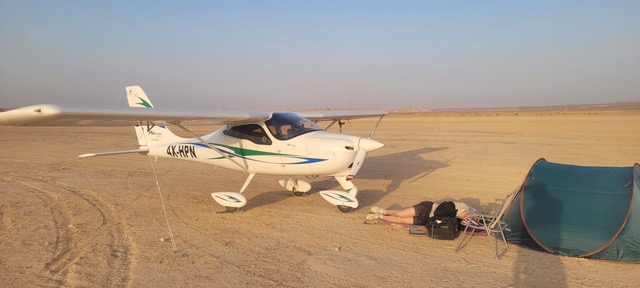
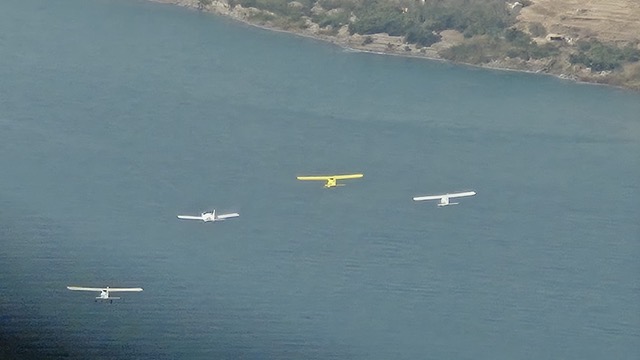
We take off and head south. Friends join us, and we continue in formation. A little over an hour later, we land on an abandoned dirt strip somewhere in the southern Negev. Friends from other airfields join us there as well.
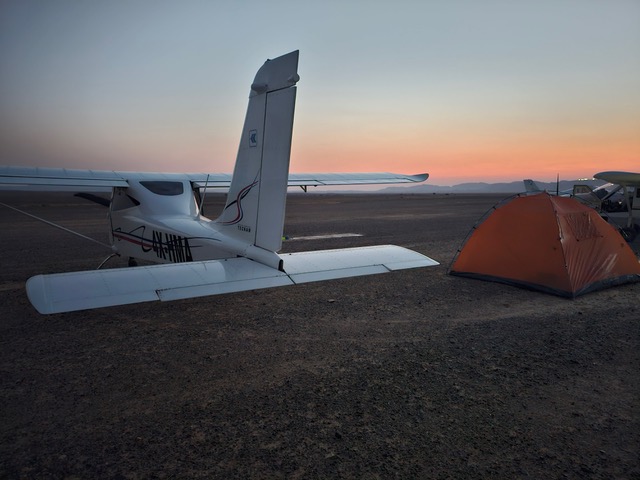
The sun will soon set, and we begin pitching our tents. Each pair settles beneath the wing of its aircraft.
Coffee. Dinner together in the open country. Stories, beers, flying experiences and plenty of laughter.
Darkness falls. We lie back on our mattresses and look upward. We deliberately chose a location with very little light pollution. The Milky Way is clearly visible, surrounded by a sky filled with countless stars.
Every so often, a meteor from the Perseid shower streaks across the sky.
Then another.
And another.
Eventually, it is time to sleep.
Five in the morning. We wake, pack up, make coffee—and take off with the sunrise.
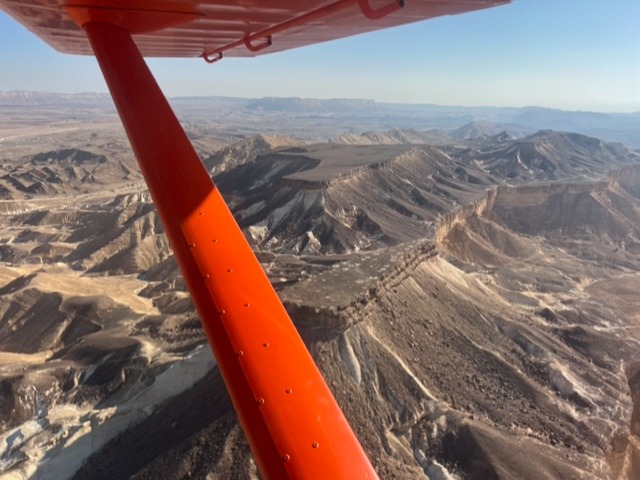
The canyons turn red in the first light. This is the hour when desert wildlife emerges in search of water before the heat of the day sets in. We encounter gazelles, onagers, wild asses and even a single Arabian oryx. Naturally, we keep our distance so as not to disturb the animals.
We land on a track near Nahal Tzihor, somewhere in the southern Negev. Breakfast—and, of course, coffee—in the shade of a tamarisk tree.
Now we can begin making our way north.
This time we fly via Nahal Nekarot toward the Arava, then continue north at low altitude along the Dead Sea. Once again, we discover the “secret river” cutting across what was once the Lisan Peninsula, and continue along the shoreline.
Every sinkhole has its own colour. The most striking of all is pink.
We begin climbing. We pass over southern Jerusalem, and the landscape changes almost instantly: the yellows and browns of the desert give way to the green of the Judean Hills.
Home is not far away now. Soon we are back in the circuit at the airfield.
Engine off. We push the aircraft back into their places.
We return tired—but full of experiences.
The Joy of LSA Flying
There is something about flying an LSA that is difficult to explain to someone who has never experienced it, and immediately obvious once you have.
It is not simply flying. It is a return to flying in its most fundamental form. Pure stick-and-rudder aviation.
No ground crew. No operations department. No technical crew.
Just you, the aircraft, the sky and the landscape.
You check the oil. You decide whether conditions are suitable for flying that day. You speak to ATC. You make the decisions.
That degree of aeronautical independence begins well before takeoff. The aircraft is yours—either wholly owned or held in partnership—and the responsibility that comes with ownership, which might at first appear to be a burden, is in fact part of the reward. It is one of the reasons LSA aircraft tend to be well maintained, clean and, quite often, relatively new.
There is also a strong social dimension. At the hangar, you are constantly meeting fellow club members who fly as well. You fly together, sometimes in coordination, learn from one another and plan future flights together.
It is more than a hobby. It is a community.
The availability of the aircraft and the relatively low cost per flight hour also make it possible to fly much more frequently, build experience and maintain a high level of proficiency. At the most basic level, the low-altitude flying characteristic of LSA operations creates an immediate connection with the landscape that is difficult to experience from the cruising altitude of a larger general aviation aircraft.
And although the aircraft may be small, that does not make it any less serious.
Many modern LSA types are equipped with glass cockpits and compare favourably with light general aviation aircraft; in some cases, they even outperform them. As a pilot holding an LSA endorsement, you can fly both the dedicated LSA routes and, with the appropriate ratings and qualifications, the conventional general aviation routes.
What differs is the nature of the flying: dedicated routes, VFR bubbles, small airfields scattered throughout the country and, in some cases, the ability to land at approved off-airfield operating sites—a field, a beach or a desert area.
The VFR bubbles deserve particular emphasis. Unlike flying along a defined route, within a VFR bubble the pilot has complete freedom to choose direction and track, subject to a specified altitude ceiling. It is a form of aviation that encourages direct contact with the country itself rather than merely passing over it.
Where Can You Fly?
Israel has one distinct advantage: its compact geography.
Within a single day, you can move from the green landscapes of the north to the southern desert, fly over Jerusalem and land near the Dead Sea—all before lunch.
Many pilots incorporate a stop for coffee in the field, a meal or, occasionally, an overnight stay beneath the stars, just as we described above. In this way, every flight becomes a story in its own right.
In practice, you can fly almost anywhere in Israel. On weekends, the country is dotted with LSA VFR bubbles—in the Negev, Galilee, Jezreel Valley, Golan Heights and Jordan Valley. Israel also has a considerable number of licensed and recognised airfields, while off-airfield landings are possible as well, subject to the appropriate qualification, the required approvals and a direct inspection of the intended landing area in advance.
A significant number of pilots entering the LSA world are highly experienced aviators—some from the Israeli Air Force, others from commercial or general aviation—who are looking for a way to continue flying after retirement without the bureaucracy, expense and more stringent medical requirements associated with commercial flying.
Others are active professional pilots looking for something additional: a relatively inexpensive and accessible way to maintain flying proficiency while enjoying the experience that, to a large extent, was the reason they fell in love with flying in the first place.
Adding an LSA Endorsement for Existing Licence Holders
Pilots who already hold a pilot licence—whether with an aeroplane rating or another category rating such as gliders—can add an LSA endorsement through a relatively abbreviated training programme.
The principal requirements, as published by the Israeli Sport Aviation Association, are as follows.
Prerequisite: A valid pilot licence with an aeroplane rating for general aviation, or alternatively a pilot licence with a rating in a category other than aeroplanes.
Theory: Two examinations are required. The first is a combined technical-knowledge and air-law examination administered through the Civil Aviation Authority of Israel (CAAI). The second is a closed-book aircraft-specific examination covering the particular LSA type on which the pilot is training; this is generally administered by the instructor or flight school.
Dual flight instruction: The requirement depends on the pilot’s previous experience. Holders of a Group A aeroplane rating are required to complete a minimum of six hours. Holders of a Group B aeroplane rating, as well as pilots holding a non-aeroplane rating such as a glider rating, are required to complete eight hours.
Pilots with more than 100 hours of accumulated pilot-in-command experience—for example, former IAF pilots who have not obtained a civilian aeroplane rating—are required to complete eight hours, including 2.5 hours solo. Apart from this latter category, no solo hours are required.
Practical test with a CAAI examiner: The test includes familiarity with pre-flight procedures, aircraft documentation, weight-and-balance calculations, checks and procedures for both normal and emergency operations, and execution of the required flight manoeuvres.
Pilots wishing to expand their flying options still further can also obtain an off-airfield operations endorsement, permitting landings away from established airfields and airports, subject to verification that the site is suitable and to the landowner’s permission.
The endorsement requires a ground briefing and three hours of dual flight instruction and does not require a specified amount of previous flying experience.
Finally, maintaining licence validity requires a proficiency check every two years, together with a requirement to fly six hours annually in each aircraft category separately. For pilots who also hold a general aviation aeroplane rating, the biennial proficiency check alternates between the aeroplane and LSA categories.
So, in conclusion, to everyone who loves flying—and particularly those approaching retirement age or who have already reached it—get in touch and come fly with us across the length and breadth of this beautiful country.
See you on frequency.
Contact: aguda@lsa.org.il