
The Israeli Pilots Association magazine

Airshows have traditionally served as arenas of competition between the industry’s giants—Boeing versus Lockheed Martin in the military sector, and Boeing versus Airbus in commercial aviation.
From a business perspective, Boeing had a very successful Farnborough 2026, overtaking Airbus with 186 firm commercial orders compared with 157 for its European competitor. This was driven primarily by major deals with Riyadh Air, Saudi Arabia’s new airline, and leasing companies such as SMBC.
Lockheed Martin, meanwhile, brought to the flying display the fighter aircraft that naturally attracts more attention than almost anything else at the show: the F-35, which quite literally shakes the exhibition halls when it lights the afterburner.
In a conversation with senior company officials, Monessa “Siren” Balzhiser, an F-35 pilot with Lockheed Martin, she told me: “These aircraft are flying operationally with the United States, with Israel and with additional coalition forces around the world. We are seeing phenomenal F-35 performances across a variety of theaters and complex operations worldwide.
“The aircraft is doing exactly what it was designed to do: accomplish the mission and bring the pilots home safely. At the same time, we are continuously listening to feedback from the field in order to understand from the pilots how we can make the platform even better.”
Amy Burnett, Vice President of F-35 Business Development, was cautious when asked about the possibility that the US administration might approve future F-35 sales to additional countries, Turkey among them.
“It is important to understand that all Foreign Military Sales, FMS transactions, are managed strictly on a government-to-government basis,” she said. “Lockheed Martin is not a political organization, and we do not speak on behalf of the US government. It is the US government that makes the final decisions about which countries will receive the aircraft.
“Questions regarding the identity of potential future customers should therefore be directed to the F-35 Joint Program Office at the Pentagon or to the US government.”
Burnett added: “Our current production rate is stable at 156 aircraft per year. The Joint Program Office manages priorities and customer allocation within each production lot very carefully. We coordinate fully with them, but the final decision as to which customer receives its aircraft and when belongs exclusively to the JPO.”
One of the most widely discussed concepts in contemporary air warfare is known as Loyal Wingman, centered on operating F-35s alongside groups or swarms of unmanned aircraft.
“We are upgrading this aircraft in much the same way that we have upgraded the F-16 over the years, an aircraft that Israel also continues to operate very successfully,” Burnett said. “Through our advanced-development division, Skunk Works, and in cooperation with our allies, we are adapting the aircraft’s roadmap to the evolving requirements of the future battlespace.”
It is worth remembering that the F-35 itself is already two decades old. Yet it remains one of the most advanced combat aircraft of its type in the world.
“The F-35 was designed to operate at least into the 2080s,” Burnett said, “so it has a very long horizon ahead of it, and its roadmap includes continuous modernization.
“The major changes now center on Block 4 capabilities and on expanding integration – that is, connecting the F-35 to other systems and platforms across the battlespace and ensuring that critical information and data can move securely in real time. Threats are evolving almost on a daily basis, and we have to remain one step ahead.”
Israel currently operates 48 F-35s. The final two aircraft needed to complete the second squadron—and bring Israel’s total fleet to 50—are now in the final logistics stages with the Joint Program Office at the Pentagon and are expected to be delivered later this year.
Israel has ordered an additional squadron from Lockheed Martin, which will ultimately bring the fleet to 75 aircraft. Under the current schedule, deliveries for the third squadron are expected to begin around 2028.
Boeing Outpaces Airbus
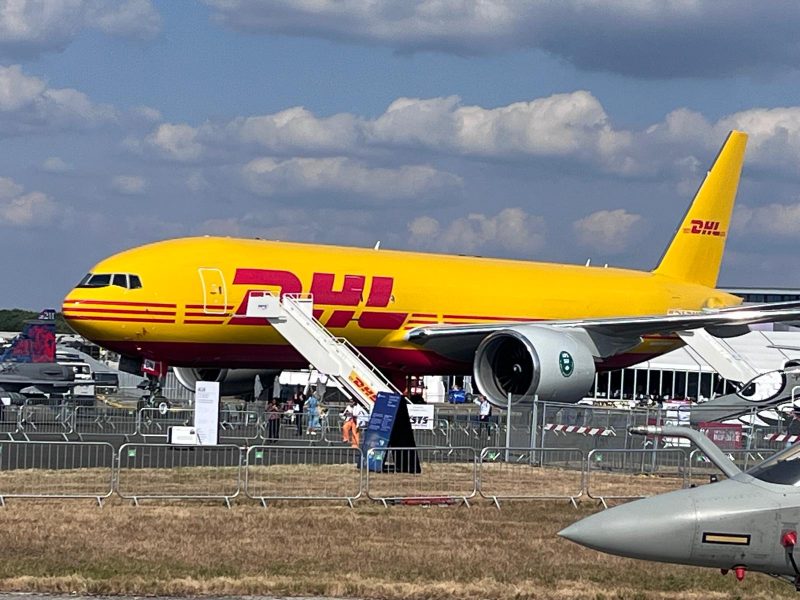
In commercial aviation and logistics, Boeing displayed a 777 freighter-conversion program in cooperation with global logistics giant DHL.
By the end of the show, Boeing had overtaken Airbus in the order race, recording 186 orders compared with 157 for its European rival. Both manufacturers, however, continue to face severe constraints throughout the global supply chain.
Boeing’s new CEO, Kelly Ortberg, said during the show that the company would need “a few more years” to stabilize its financial position before it could launch an entirely new passenger aircraft.
At the center of Boeing’s military display was the advanced autonomous MQ-28 Ghost Bat, originally developed by Boeing Australia for the Royal Australian Air Force.
Designed around the Loyal Wingman concept, the UAV is intended to operate alongside crewed fighter aircraft, providing protection, intelligence and tactical support while incorporating advanced artificial intelligence.
Boeing’s commercial flying display was more restrained this year, with greater emphasis placed on safe maneuvering and low-speed handling characteristics.
The Boeing 737 MAX was particularly prominent. It participated in the daily flying display and demonstrated short-field takeoff performance and impressive low-speed maneuvering, intended in part to showcase the effectiveness of its two-stage aerodynamic flap system and its suitability for operations from shorter runways.
On the ground, Boeing focused particularly on advanced unmanned aircraft and on a preview of the future passenger experience.
Inside its official pavilion, the company created a number of technologically advanced immersive demonstration areas, including a full-scale 777X cabin section.
The interactive installation allowed visitors and airline representatives to experience the wide cabin, larger windows and enhanced ergonomics of Boeing’s next-generation flagship aircraft.
Airbus, for its part, displayed the A350-1000, the largest twin-engine widebody in its portfolio.
During the flying display, the aircraft performed short takeoffs, steep climbs and high-bank-angle maneuvers exceeding 60 degrees, demonstrating substantial power availability and impressive aerodynamic performance for an aircraft of its size.
As part of Airbus’ effort to emphasize sustainability, the A350 aircraft participating in the flying displays operated using a blend containing 30 percent Sustainable Aviation Fuel, or SAF, in support of the company’s broader strategy to reduce carbon emissions.
Airbus’ static display included aircraft from the A321XLR and A350 families. The aircraft—and particularly the A321XLR—were used to demonstrate the ability to connect distant city pairs that previously could not be served nonstop by a narrowbody aircraft.
Also on display was the Airbus H160, one of the newest models in the company’s helicopter portfolio.
It stood out particularly because of its distinctive Blue Edge rotor blades, designed to reduce noise and vibration, as well as an overall configuration tailored to missions including search and rescue, emergency medical services and passenger transport.
In the military segment, Airbus displayed its well-established A400M Atlas, a heavy transport aircraft shown in active cooperation with the Royal Air Force and accompanied on the ground by Jackal military reconnaissance vehicles.
Airbus also unveiled an unmanned aircraft concept that attracted considerable attention: the U760 Ravenstorm.
The company presented the advanced UAV concept as part of its Collaborative Combat Aircraft, or CCA, work—unmanned combat aircraft designed to operate in conjunction with crewed fighters.

The Third Player: Embraer
This year’s Farnborough International Airshow offered a clear indication of the deep structural changes taking place across the global aerospace industry.
While the two dominant manufacturers, Airbus and Boeing, continue to grapple with complex supply-chain challenges, regulatory delays and difficulties in increasing production rates, Brazil’s Embraer is demonstrating consistent commercial and operational momentum.
With its order backlog at a historic high and aircraft delivery gradually increasing, the company is increasingly establishing itself as the world’s third-largest aircraft manufacturer, while expanding its position in both the commercial and defense markets.
In commercial aviation, Embraer’s strategy focuses on dominating the regional and small narrowbody segment.
The E195-E2, displayed at the show, is now regarded as one of the most efficient and economical aircraft in the small narrowbody category, thanks to low fuel consumption and competitive operating costs.
That advantage contributed to a number of significant follow-on agreements signed during the airshow.
Rather than attempting to compete directly with large widebody aircraft, Embraer is exploiting production gaps and capacity constraints among its larger competitors by offering airlines a readily available alternative for regional and medium-haul routes.
This strategy is also being reinforced by the company’s entry into the cargo market, highlighted by the debut of the E190F, a dedicated freighter version intended to address growing demand in the express-logistics sector.
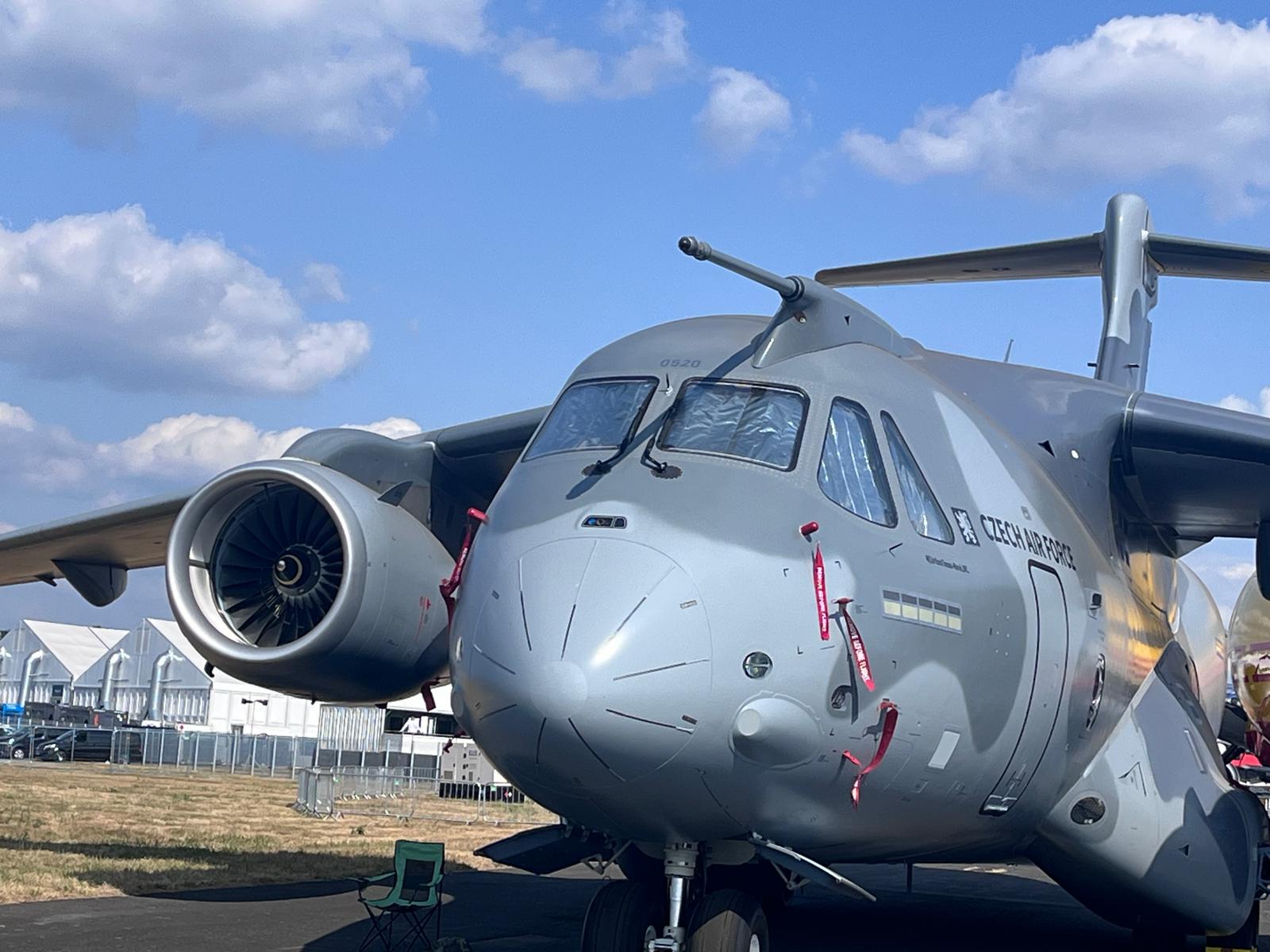
Alongside its expansion in the commercial market, Embraer is also establishing an increasingly significant position in the global defense sector through the KC-390 Millennium multirole transport and tanker aircraft.
During fly-past and flying displays at Farnborough, the aircraft demonstrated a combination of jet-speed performance with the ability to take off and land from short and semi-prepared runways.
The KC-390 is now positioned as a modern and advanced alternative to the long-established C-130 Hercules family and is increasingly challenging the decades-long dominance of the US aerospace industry in this market segment.
A central factor in the success of Embraer’s military business is its growing penetration of the European market, particularly among NATO member states.
Shortly before the opening of the airshow, the Czech Air Force received its first KC-390, while additional agreements and strategic partnerships were announced in Europe during the show itself.
The Czech Republic’s decision to join countries such as Portugal, Hungary, the Netherlands and Austria in selecting the aircraft indicates that Embraer has succeeded in establishing itself as a permanent and increasingly important participant in Western defense procurement.
The picture emerging from Farnborough is clear: the combination of stable production, an ability to meet immediate commercial requirements, and modern military technology is turning the Brazilian manufacturer into an influential and increasingly durable force in the architecture of global aviation.