

The Israeli Pilots Association magazine
Following an unprecedented surge in incidents involving lithium batteries and portable chargers catching fire mid-air, the global aviation industry has responded with a wave of bans and dramatic restrictions regarding their carriage on board aircraft * Israeli airlines, led by El Al and Arkia, have also adopted the strictest international protocols.

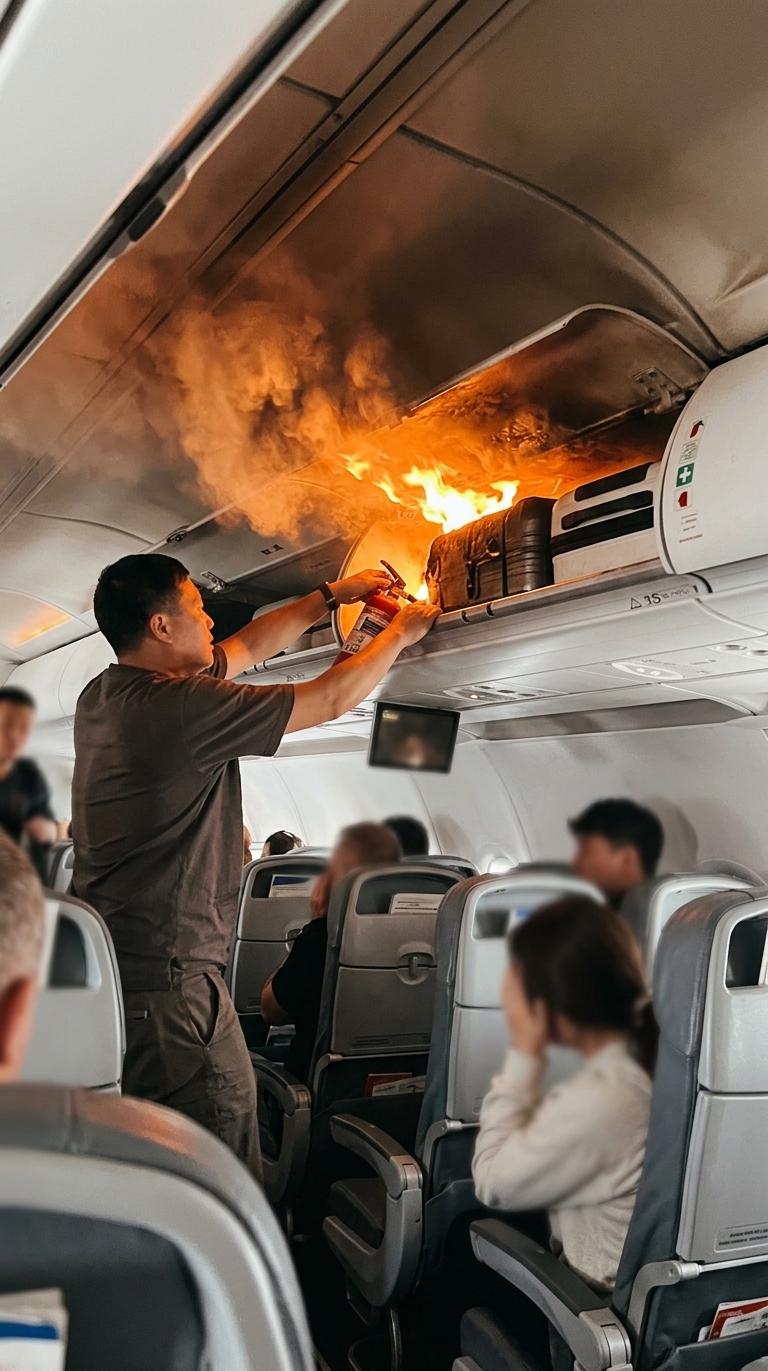
In the modern world of aviation, where navigation systems are incredibly precise and aircraft are safer than ever, the greatest threat to flight safety does not necessarily come from an engine failure or a formidable storm, but rather from the seat pocket of the passenger in row 12. The dramatic spike recorded in recent years in the number of lithium battery and portable power bank fire incidents on commercial flights has turned these small cubes of energy into the primary concern for captains and safety officials worldwide. According to data from the US Federal Aviation Administration (FAA), the industry is currently facing a worrying average of more than one incident per week in which a battery experiences thermal runaway—a destructive chemical process where it overheats extremely, emits thick smoke, and often explodes, turning into a burning torch.
To understand the magnitude of the danger, one only needs to look at a series of severe recent incidents, which illustrate how such an everyday item can disable a metal giant in the skies. In September 2026, a KLM flight en route from Amsterdam to Curaçao was forced to make an urgent U-turn over the Atlantic Ocean and return for an emergency landing after a portable charger left plugged into an outlet in business class caught fire. The flames and heavy smoke severely scorched the window panel and seat, leaving one passenger injured with burns.
Just a few months prior, in October 2025, an EasyJet aircraft on the tarmac in Milan was forced to conduct an urgent emergency evacuation via inflatable slides after a passenger's power bank suddenly exploded, filling the cabin with suffocating smoke within seconds—an incident that resulted in injuries to two people. The most extreme case was recorded in South Korea, where an Air Busan aircraft was almost completely destroyed on the ground and burned to ashes following the thermal runaway of a portable charger.
The inherent danger in these batteries lies in the combination of their high energy density and the physical difficulty flight crews face in controlling the chemical fire they produce. When a lithium battery fails due to a manufacturing defect, internal damage, or a short circuit, it generates self-heating that feeds into a chain reaction, requires no external oxygen, and emits toxic, scorching gases. The threat becomes exponentially catastrophic when it occurs in the aircraft's cargo hold. For this reason, in May 2026, an EasyJet flight bound for London executed an immediate emergency landing in Rome from an altitude of 11,000 meters, solely because a passenger remembered they had left an active power bank inside a suitcase checked into the cargo hold. The captain refused to take the risk, as a battery fire in the enclosed cargo compartment—an area where flight attendants have no direct access and no ability to fight the fire in a targeted manner—is considered one of the most threatening scenarios to an aircraft's survival.
Following this unprecedented wave of incidents, the global aviation industry responded with a wave of bans and dramatic restrictions that are completely changing the familiar flight experience. Leading airlines worldwide have aligned with rigid protocols designed to neutralize these ticking time bombs even before takeoff. Israeli airlines, led by El Al and Arkia, have also adopted the strictest international protocols, placing themselves at the forefront of the battle against this fire hazard. The meticulous inspections at Ben Gurion Airport, combined with the latest safety updates, have turned the carriage of portable chargers and electronic storage devices into a highly controlled and rigid procedure, placing full personal responsibility on the passenger.
The Single Charger Rule
The most basic and vital rule for the Israeli passenger today is the "Single Charger Rule," which dictates only one portable power bank per passenger, with El Al strictly banning the carriage of multiple disconnected backup power banks for a single passenger. Beyond the quantity, there is a rigid capacity restriction based on energy units of Watt-hours (Wh), setting a maximum threshold of up to 100 Watt-hours. Most of the popular power banks on the market, such as 10,000 or 20,000 mAh batteries operating at a standard internal voltage of 3.7 volts, meet this criterion, as a 20,000 mAh battery is equivalent to exactly 74 Watt-hours. However, a prerequisite for bringing the charger on board is the presence of an original, clear, and legible manufacturer marking that stamps this data onto the device. Ground and security crews are instructed to reject and confiscate worn-out, erased chargers, or power banks without clear technical specifications.
The moment a passenger crosses the aircraft bridge and enters the passenger cabin, the portable charger must become a completely dormant object, as Israeli airlines implement a sweeping and absolute ban on its use throughout all phases of the flight. Connecting mobile phones, tablets, or headphones to a portable power bank while on board is strictly prohibited, and it must remain completely turned off and disconnected inside the bag. Similarly, the backup battery itself must not be charged using the built-in power outlets or USB ports in the aircraft seats. These chargers are defined under aviation law as dangerous goods, and consequently, it is strictly forbidden to send them inside luggage designated for the aircraft's cargo hold; they must be carried exclusively within carry-on baggage. Furthermore, passengers are required to ensure active protection against short circuits, which means carrying the batteries inside a dedicated protective pouch or a separate pocket in the bag, keeping them completely away from conductive metal objects like keys or coins that could cause a sudden short circuit and a thermal chain reaction.
Regarding batteries permanently installed inside electronic devices, Israeli policy is divided into three clear categories:
The aviation industry is making it unequivocally clear to the modern passenger that while technological convenience is important, it will never come at the expense of the rigid safety rules that keep the aircraft in the air.